
Innovator · INNOVATION Manitoba
Perimeter Aviation
Built for the North
Operating in northern Manitoba demands ingenuity. Perimeter Aviation cannot simply adopt solutions designed for major airports or southern markets and assume they will work. Aircraft, facilities, technology, customer experience, and processes all have to account for a different operating reality.
When Constraint Drives Innovation
For more than six decades, those realities have pushed Perimeter to adapt, evolve, and find better ways forward in a place where aviation is not simply transportation.
In many northern communities, flights connect people with health care, education, employment, family, goods, and essential services. Distance, weather, gravel runways, and limited infrastructure shape every decision.
Innovation at Perimeter has never been about change for the sake of change. It is about understanding the people and places the airline serves, identifying where something can work better, and being willing to rethink how it’s done.
That’s what makes its innovation distinctly Manitoban: practical,
place-based, and shaped by the geography and communities of the North.
“The North requires a different kind of thinking,” says President and CEO, Joey Petrisor. “You have to understand where the constraints are and determine how to operate safely and effectively within them, or find a way to overcome them.”
Engineering for the Environment
That thinking begins with the aircraft themselves.
For decades, the Metroliner was a cornerstone of Perimeter’s northern fleet. Its performance on gravel runways made it well suited to the network, but suitability was only the starting point. The aircraft still had to be adapted for the realities of ice, cold weather, and remote operations.
Specialized erosion protection and sealants helped mitigate damage, while purpose-designed cargo systems supported freight movement into remote communities. Perimeter’s maintenance organization also developed design approval capability, allowing technical solutions to grow from operational experience inside the network.
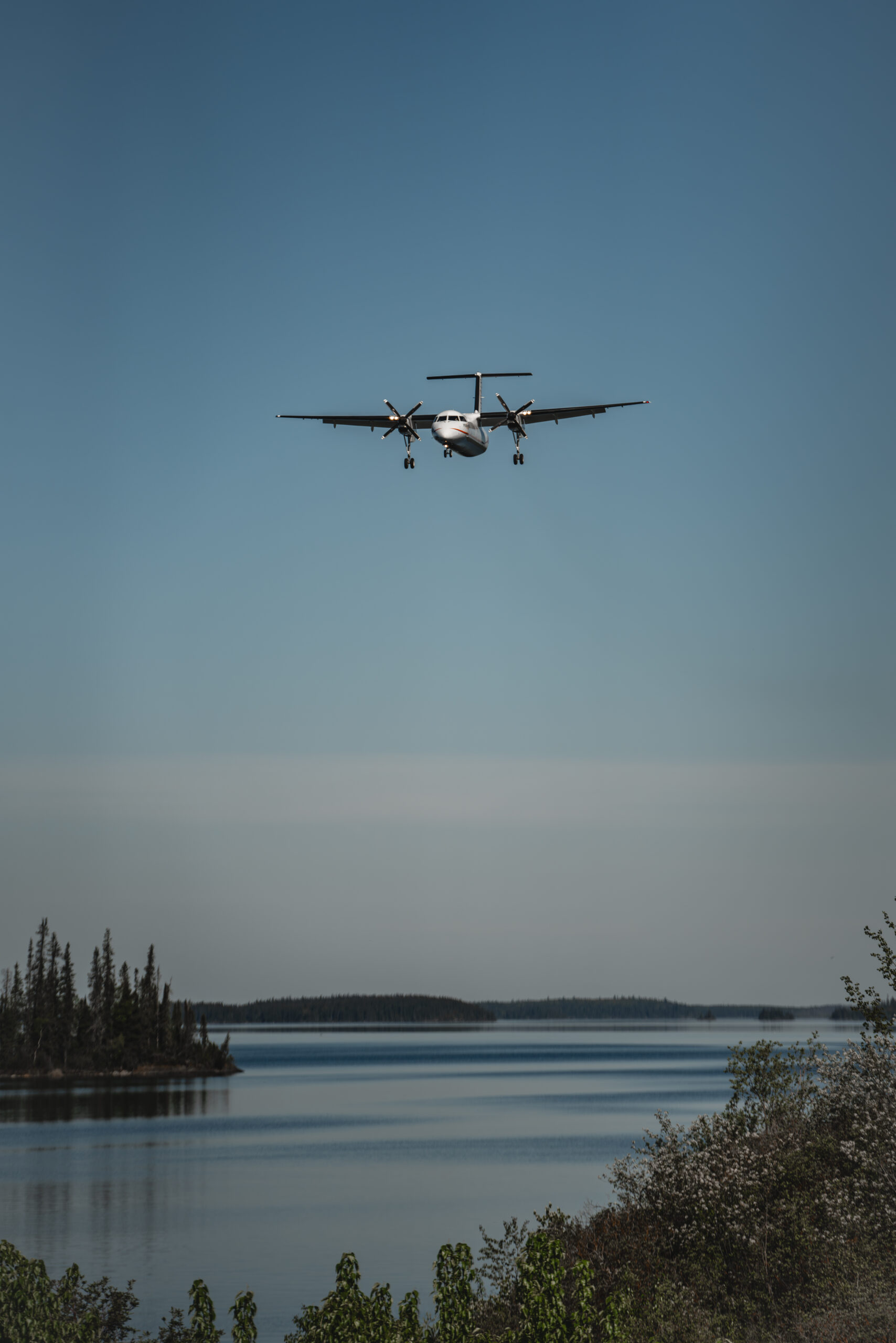
Today, as Perimeter expands its Dash 8 fleet, the same philosophy is shaping a new generation of aircraft. Protective belly wraps, for example, extend higher along the fuselage to reduce damage from gravel and debris on unpaved runways, an adaptation informed by decades of northern flying.
The aircraft may evolve, but the principle remains: the fleet must be shaped around the geography and the communities it serves.
Building What Isn’t There
At major airports, paved runways, reliable connectivity, and specialized ground infrastructure are largely taken for granted. Across a remote northern network, those assumptions fall away. Perimeter has to adapt to that reality and, at times, help build around it.
Its deicing program has evolved alongside advances in custom equipment, fluids, and technical expertise. Accessibility improvements have followed the same practical logic, introducing safer, more workable ways for passengers with mobility needs to board aircraft in remote locations.
Technology is also helping bridge infrastructure gaps. Connectivity across Perimeter’s airport network gives operational teams greater visibility into local conditions and critical infrastructure before an aircraft arrives, supporting better planning and more informed decisions.
Perimeter is also working with industry partners to address constraints at their source, including exploration of thin bituminous runway surfaces as an alternative to gravel. The goal is to reduce aircraft damage while improving operational capability in communities where full paved-runway infrastructure may not be practical.
Designing For People
Perimeter’s $19.35-million expansion of its Winnipeg terminal in 2025, extends the same place-based approach to the passenger experience. Rather than follow a conventional airport model, the project considered how families, Elders, passengers with accessibility needs, and those less familiar with air travel move through the journey.
The result integrates accessibility, clear wayfinding, improved passenger flow, and dedicated spaces for families and Elders. It reflects the same principle that shapes the broader operation: design around the people being served, not around assumptions imported from somewhere else.
Precision in a Complex Environment
In northern aviation, incremental improvements can have disproportionate value.
Perimeter’s work with NAV CANADA on more precise electronic obstacle information and flight procedures aims to give crews better information in complex environments. Greater precision can improve operational consistency while preserving payload that might otherwise be restricted.
Here, payload is more than an efficiency measure. Additional capacity can mean more essential freight, medical equipment, or another passenger reaching a community that depends on aviation as a lifeline.
That same pursuit of precision extends to how people are prepared. Perimeter uses instrument and cockpit procedure training systems to build pilot proficiency before crew’s progress to full-motion simulation. Simulation is also being extended to maintenance personnel, giving teams a controlled environment to develop specialized skills before applying them in complex operational settings.
“Our environment doesn’t allow us to separate innovation from safety,” says Petrisor. “Better information, better equipment, and better preparation all contribute to the same objective: giving our people the tools they need to operate safely and serve our passengers reliably.”
For Perimeter Aviation, the constraints of northern Manitoba have rarely been reasons to accept what cannot be done. They have defined the problems worth solving and shaped an organization that continues to find practical, safer, and more reliable ways to connect the people and communities it serves.
Have an innovation story of your own?
We welcome stories from founders, companies, researchers and organisations building something new, from any ecosystem.
Submit it for consideration